Audit-Ready Compliance

Audit-Ready Compliance for the brand buyer who has to defend every receipt.

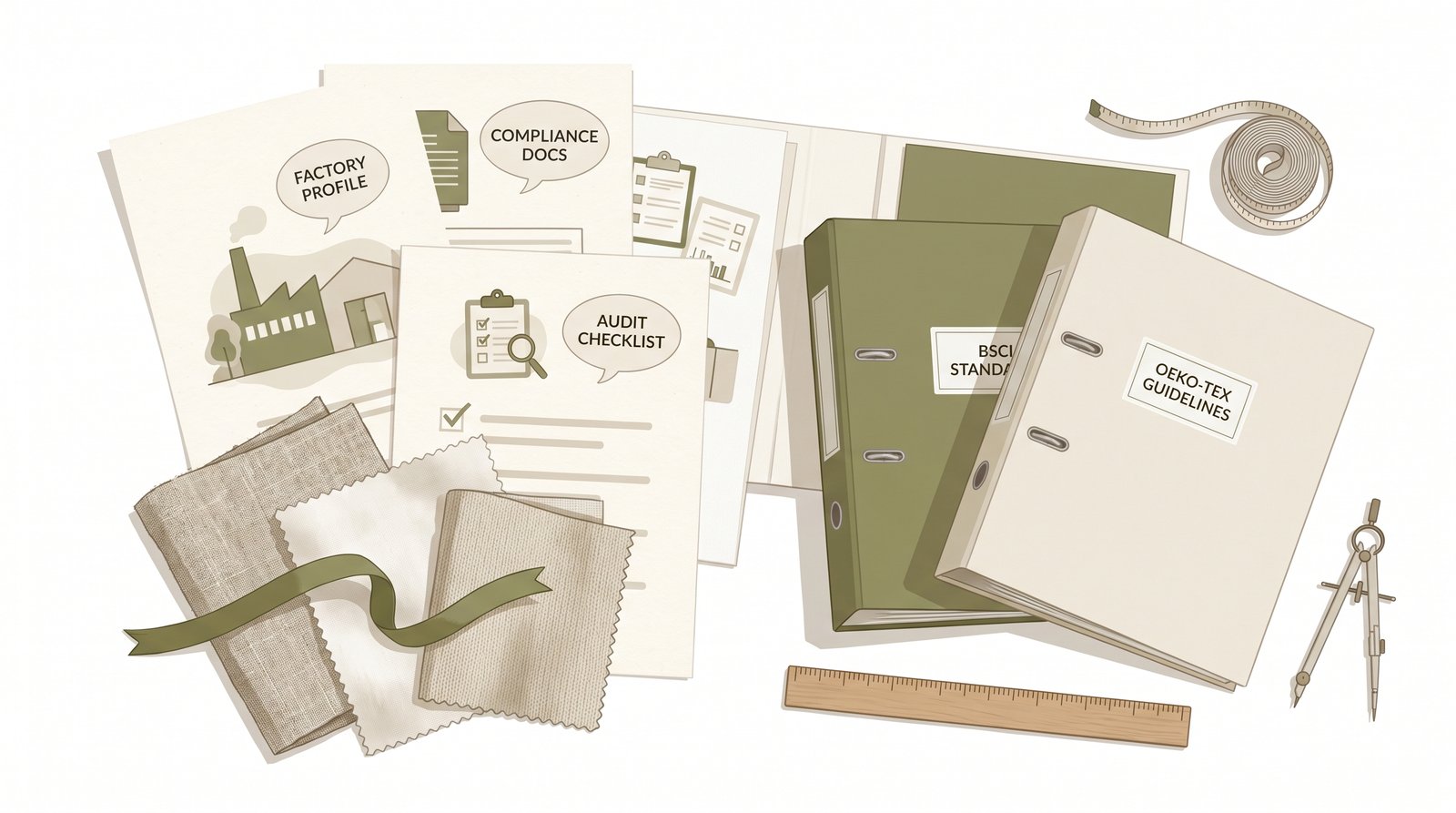
Documentation pack, third-party audit hosting, retailer-grade conformity flow. The same paperwork your compliance lead chases at month-end is the paperwork that already sits on this floor — ready to ship under signed NDA the same business day.

  • Documentation pack on request
  • Third-party audit hosting
  • Retailer-grade conformity

Documentation pack returns within 1 business day. NDA template available before any test report, audit letter, or certificate copy leaves this building. No screenshots, no recycled PDFs.

  • Audits hosted BSCI · Sedex SMETA · SLCP · WRAP · Higg FEM
  • Documentation pack Factory profile · capability statement · RSL letter · test reports
  • Markets covered US (CPSIA) · EU (REACH) · CA (CCPSA) · Prop 65
  • Chemical safety AZO-free dyes · PFAS-free DWR option · BPA-free elastic
  • Code of conduct Supplier code · working-hours policy · audit cadence
What We Maintain

The four standards we keep active on this floor — and what each one actually proves.

Each is held under the operating-company name. We won’t publish certificate numbers on a public page — they go stale, they get screenshot-scraped, and a number on a public page is the easiest forgery in this industry. Numbers and expiry dates travel under signed NDA, direct from the certification body, to your compliance inbox.

OEKO-TEX Standard 100

Fabric · harmful-substance testing

  • What Tests finished textile against the Annex 6 limit list — azo dyes, formaldehyde, heavy metals, chlorinated phenols, pesticides, organotins.
  • Issuer An OEKO-TEX member institute (Hohenstein / TESTEX-class testing house, independent of the factory).
  • Why ask Most US and EU brand RFQs require Class I (skin-contact, infant) or Class II (skin-contact, non-infant) coverage on the fabric roll before tech-pack signoff.
  • We provide Current certificate letter, scope confirmation, batch-level mill paperwork — on request, on signed NDA.
BSCI Social Compliance Audit

Factory · amfori social audit

  • What amfori BSCI audit of social compliance — working hours, wages, child labor, forced labor, occupational health, freedom of association.
  • Issuer A third-party amfori-accredited audit firm. We don’t self-issue this report.
  • Why ask Retailer onboarding programs (especially large US and EU buyers, and value-chain retailers) require a BSCI result on file, refreshed on the standard cycle.
  • We provide Latest BSCI report under signed NDA. Re-audit cadence and the corrective-action log available on request.

ISO 9001 Quality Management System

Operations · QMS framework

  • What Documented process control, traceability, supplier control, calibrated measurement, corrective-action loop. The procedures behind every order.
  • Issuer An IAF-accredited certification body. Surveillance audits on the standard cycle.
  • Why ask It shows the floor runs by documented procedures rather than tribal knowledge. Useful for retailer due-diligence and tender qualification.
  • We provide Current QMS scope letter and the procedure index. Full document set under signed NDA.

Sedex SMETA Membership

Ethical sourcing · 4-pillar audit

  • What Sedex platform membership plus the SMETA 4-pillar audit — labor, health & safety, environment, business ethics.
  • Issuer A Sedex AB-accredited audit firm. Report posted to the Sedex platform; member ID verifiable by the platform.
  • Why ask Many UK and European retailers, and US private-label programs that onboard through Sedex, require SMETA 4-pillar coverage as a precondition to PO release.
  • We provide Latest SMETA report and CAPR under signed NDA. Auditor contact letter on request.

Specific certificate numbers and expiry dates are intentionally not shown on this page — they travel by letter, on signed NDA, directly to your compliance inbox. Anything otherwise is a screenshot, and a screenshot defends no audit. Once you’re inside the wholesale yoga apparel program, the pack rides along with every PO.

Audit Hosting Workflow

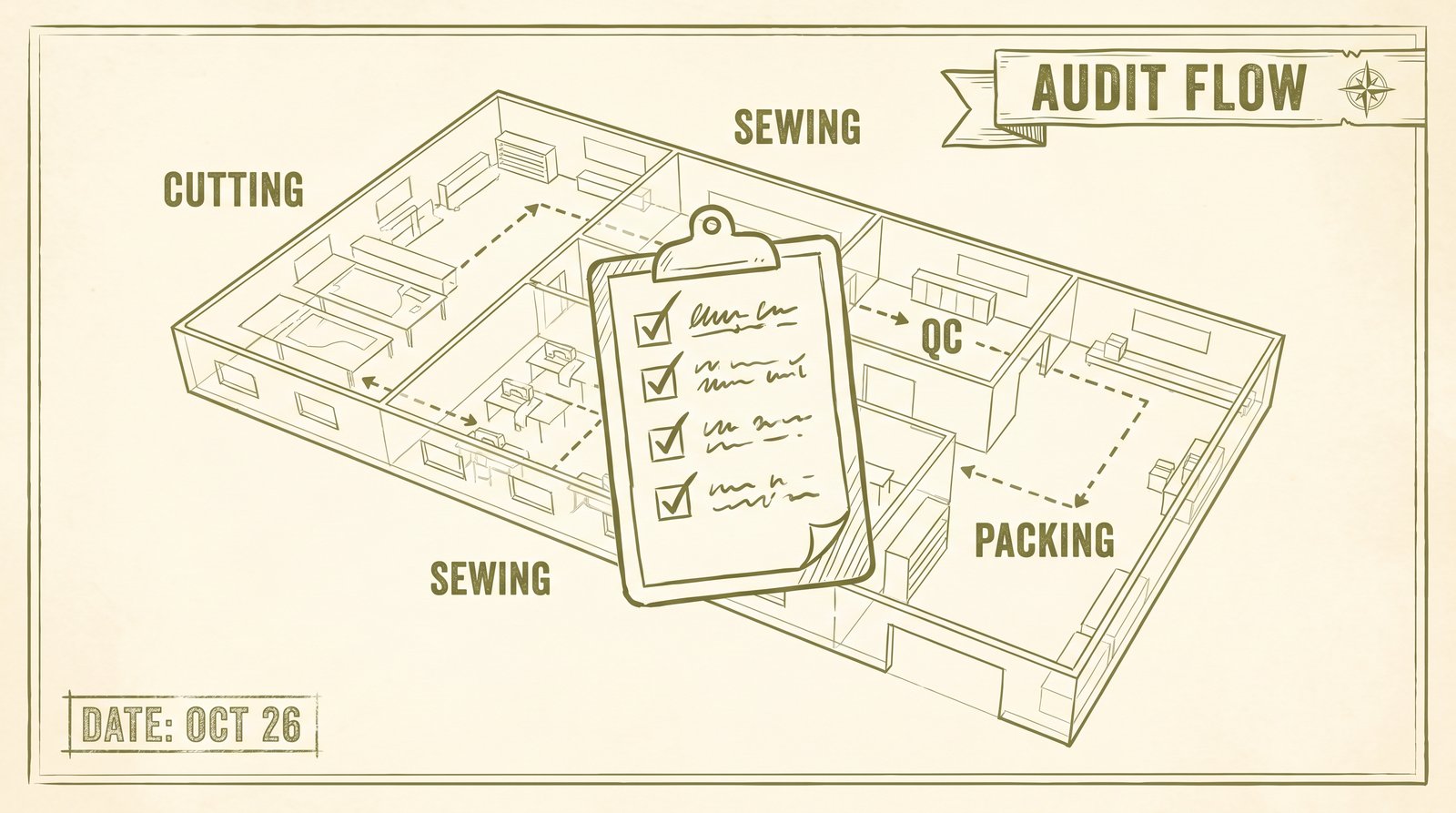
How we host your auditor — pre-audit through corrective action, on the route they choose.

Whether the auditor arrives under SMETA, SLCP, WRAP, Higg FEM, BSCI re-audit, or your own brand standard, the workflow is the same. We don’t change the floor for an audit week; we open it.

  1. T − 21 days

    Pre-audit prep package

    • Scope confirmation with the auditor
    • Document checklist returned filled — HR registers, payroll samples, machine maintenance logs, calibration records, fire-system test logs
    • Floor map and shift roster shared
    • Named compliance lead assigned (not a rotating receptionist)
  2. Audit day · hour 0

    Auditor briefing

    • Opening meeting in the conference room next to the production floor
    • Auditor walks the route they choose, not the route we choose
    • Worker interview list drawn from the live roster — no curated panel
  3. Audit day · hours 1–5

    Walk-through

    • Sewing floor, cutting room, fabric store, chemical store
    • Fire-equipment points, fire exits, dorm building where applicable, canteen
    • Document room access is continuous, not appointment-based
    • Photo permissions per the audit standard
  4. Audit day · close

    Findings session

    • Closing meeting same day
    • Findings shared in writing, classified by severity per the audit standard
    • We sign the findings even when we don’t like them — disputing in the closing meeting is faster than disputing on the CAP
  5. T + 30 / 60 / 90

    Corrective action follow-up

    • Written corrective-action plan filed within the audit standard’s deadline
    • Evidence package each milestone — photos, updated logs, training records
    • Re-audit window booked in writing, not “we’ll get to it”

Standards we have hosted

SMETA 4-pillar, SLCP, WRAP, Higg FEM, BSCI re-audit, and retailer-specific brand audits (multiple US and EU programs). Auditor reference letter available under NDA.

Standards we will host on request

Most internationally recognized social-compliance and environmental-compliance audits with reasonable scope and notice. Name the standard at brief; we confirm route and schedule the same week.

Documentation Pack

Nine documents in one envelope — not a six-email scavenger hunt.

A brand-buyer compliance lead asks for the same nine documents on every onboarding. We keep them current. We ship the pack as a single PDF set, or push it through your supplier portal — whichever your team prefers.

Document Format & delivery
Factory profile — location, floor area, headcount, ownership, year established PDF, 2-page brief. Sent at first qualified inquiry.
Production capability statement — product families, machine list, monthly capacity PDF, signed by operations lead.
OEKO-TEX Standard 100 certificate letter (current) PDF letter from the testing institute, under NDA.
BSCI latest audit summary PDF under NDA, with auditor contact letter.
Sedex SMETA latest report & CAPR PDF under NDA. Member ID confirmable on the Sedex platform.
RSL conformity letter — restricted substances list PDF on letterhead, referencing the buyer’s RSL if provided.
Chemical compliance attestations — REACH, Prop 65, CPSIA, CCPSA where applicable PDF letter per market. Refreshed on policy change.
Fabric test reports (per shipment, on spec) PDF from a third-party lab — Intertek / SGS / Bureau Veritas-class.
Supplier code of conduct (signed) PDF, returned counter-signed by the buyer’s legal team.

Delivery format

One zipped PDF set, or pushed into your supplier portal — we’ve onboarded onto retailer portals before; share the link with the inquiry.

Refresh cadence

Every document carries its issue date. Test reports refresh per shipment. Audit reports refresh on each new audit cycle. No expired PDF goes out the door.

The same pack rides along with each shipment under our traceable fabric supply chain flow — documentation matched batch-to-batch, not bundled-once-then-forgotten.

Market Compliance

The honest answer per market regime — maintained, on request, or not yet.

A compliance lead’s question isn’t “are you certified.” It’s “can you meet my market’s rule.” Four answers below, with the deliverable spelled out so your legal team doesn’t have to chase.

United States · CPSIA

Children’s apparel safety

Prepared on request

We route children’s-size apparel through a CPSIA-conformant testing flow — lead content, phthalates where applicable, small-parts testing as relevant, tracking-label requirements applied at the size run.

Deliverable: General Certificate of Conformity (GCC) per shipment, lab test reports from a CPSC-accepted lab, tracking-label specification document. Flag children’s SKUs at quote so we route them through the CPSIA path from sample, not after.

California · Prop 65

Listed-substance exposure

Maintained

Our standard fabric-mill test protocol covers substances flagged for textiles under Prop 65 — notably DEHP and other phthalates relevant to coated and printed components, and azo-derived amines.

Deliverable: Prop 65 conformity letter referencing the latest testing batch. Substance data your counsel needs to make the warning-label decision — we don’t tell you which label to use, that’s a legal call, but we give you the underlying numbers.

European Union · REACH + CLP

SVHC candidate list + classified components

Maintained

Fabric and trim suppliers are tested against the latest SVHC candidate list. SDS available for any chemical input on the production floor — DWR, dye, finish.

Deliverable: REACH SVHC conformity declaration referencing the latest candidate-list publication date. SDS sheets on request. CLP-aligned labeling where the product carries any classified component.

Canada · CCPSA

Health Canada consumer product safety

Prepared on request

We follow Health Canada’s CCPSA flow for adult and children’s apparel, including the flammability requirements relevant to apparel categories under the Textile Flammability Regulations.

Deliverable: Written attestation per shipment. Flammability testing where the SKU category requires it. Bilingual labeling where the SKU ships into the Canadian retail channel.

If your market isn’t listed — Australia, Japan, South Korea, GCC — name the regulation. We come back the same week with a route, or a straight “not yet” so you don’t burn a quarter on a path that won’t ship.

Chemical & Material Safety

What’s in the fabric — and what isn’t.

“What’s in your fabric” is a compliance-defending question, not a marketing question. The split below is the answer in the form a tech-pack reviewer can paste into their spec sheet.

Maintained on standard fabric base

Already in the spec, no add-on cost

  • OEKO-TEX Standard 100 coverage — Class II for skin-contact apparel, Class I when the buyer’s spec asks for it.
  • AZO-free dyes — no banned aromatic amines under EU directive 2002/61/EC.
  • Phthalate-controlled prints and coatings — within the limits referenced for textile use under REACH and Prop 65.
  • BPA-free elastic — confirmed with our elastic suppliers; declaration available on request.
  • Heavy-metal screening — included in the fabric-roll test protocol.
  • Formaldehyde — within OEKO-TEX limits for the relevant product class.

Available on request

Routed through the testing flow before order locks

  • PFAS-free DWR — fluorine-free water-repellent finish where the spec requires it; we route through a fluorine-free chemistry supplier and re-test the finished roll.
  • bluesign® system partner mill option — for buyers whose brand standard requires bluesign-listed inputs.
  • Recycled fiber content (rPET, recycled nylon) with GRS / RCS chain-of-custody — through GRS-certified fabric mills, batch-traceable.
  • Organic cotton with GOTS chain-of-custody — for cotton-blend categories. Mill-side certification, not factory-side.
  • OEKO-TEX MADE IN GREEN — product-level traceability label where the buyer wants the consumer-facing claim.

Test certificate flow. Per-shipment test reports from a third-party lab — Intertek / SGS / Bureau Veritas-class — when the buyer’s spec calls for testing. We authorize the lab to release directly to your compliance inbox so the report doesn’t pass through us. No edit-in-the-middle, no “summary version.”

The chemistry rules above feed straight into our OEKO-TEX fabric selection guide — the same input list, mapped to specific roll options by category.

Code Of Conduct

Three rules behind the audit — steady-state, not snapshot.

The audit is a snapshot. The code is the steady-state. Three rules anchor it. They’re the rules the auditor checks against, the rules HR onboards new hires against, and the rules we won’t cross to win an order.

01

No child labor. No forced labor.

Minimum hiring age verified through government-issued ID at onboarding. Worker-recruitment policy bans bonded labor, deposit-style hiring, and any fee charged to a worker for a job. The policy is documented; the policy is audited; the policy is the line we won’t cross to win an order.

02

Working hours and wages within local law.

Overtime is voluntary and paid at the legally required premium, recorded on the same time-and-attendance system the auditor pulls from. Wages clear monthly by bank transfer, with payslip. If a brand standard caps hours below the local-law ceiling, we run to the brand standard for that order.

03

Supplier code, audited annually.

Fabric mills, trim suppliers, and decoration sub-contractors sign the same code we sign. They’re audited on a cadence too — by us at minimum, by BSCI / SMETA where their volume justifies a third-party audit. A non-compliant supplier loses the order, not the audit.

Audit cadence. BSCI on the standard re-audit cycle. SMETA on the standard 4-pillar cycle. Internal HR walk-through monthly. Document refresh aligned to each audit calendar invite. Auditor contact letter available on request.

The same code applies on every OEM custom yoga apparel build — no carve-out for “rush” orders, no shortcut for “just this once.”

Audit-Readiness FAQ

Eight questions a compliance lead asks before the first PO.

The questions a brand compliance lead actually asks in onboarding email three, after the small-talk. Answers below, written the way we’d answer them in a call.

Can you support an unannounced audit?

Yes, within the auditor’s standard protocol. SMETA and SLCP both allow semi-announced and unannounced windows. We hold the audit access policy open during the agreed window; the auditor picks the day.

How fresh is your latest BSCI / SMETA report?

Both within the standard re-audit cycle. Exact issue date and report copy travel by NDA letter to the compliance contact you nominate — same business day on a qualified request. We don’t put issue dates on a public page; they go stale and become a hostage to fortune.

Will you accept my own auditor or my retained third-party firm?

Yes. Brand audits, retained firms, retailer-mandated audits — we host. Scope and notice as defined by the audit standard. We don’t carve out rooms or shifts.

Will you let the auditor speak to workers without a manager in the room?

Yes. Worker interviews follow the audit standard — random selection from the live roster, private setting, manager out of the room. That’s the whole point of the audit.

How do you respond to a corrective-action plan finding?

Written plan within the audit standard’s deadline (typically 30, 60, or 90 days depending on severity). Evidence package per milestone — photos, updated logs, training records, refreshed procedures. Re-audit scheduled in writing. We close findings, we don’t argue them away.

Can you sign my supplier code of conduct?

In most cases yes — and we counter-sign before the first PO. Where a clause conflicts with local labor law (rare, but it happens), we flag it in writing rather than sign blind. Honest signatures only.

Can you ship to a market my legal team hasn’t seen on this page?

Name the regulation and the SKU family — Australia AAFA, Japan METI cosmetic-adjacent rules, GCC textile labeling, anywhere. We come back the same week with either a route (“we’ll route the order through this testing flow, here’s the deliverable, here’s the cost adder”) or a straight “no.” A fake yes loses you a year; saying no in week one is cheaper than apologizing in quarter three.

How do I actually get the documentation pack?

Send the inquiry form below and mention “documentation pack.” We route the signed-NDA template the same business day. The pack lands as a single zipped PDF set, or via your supplier portal — whichever your team prefers.

NDA template + pack outline within 1 business day. No auto-replies, no chatbots — a real person reads every compliance brief.